By Curtis C. Brown CEO
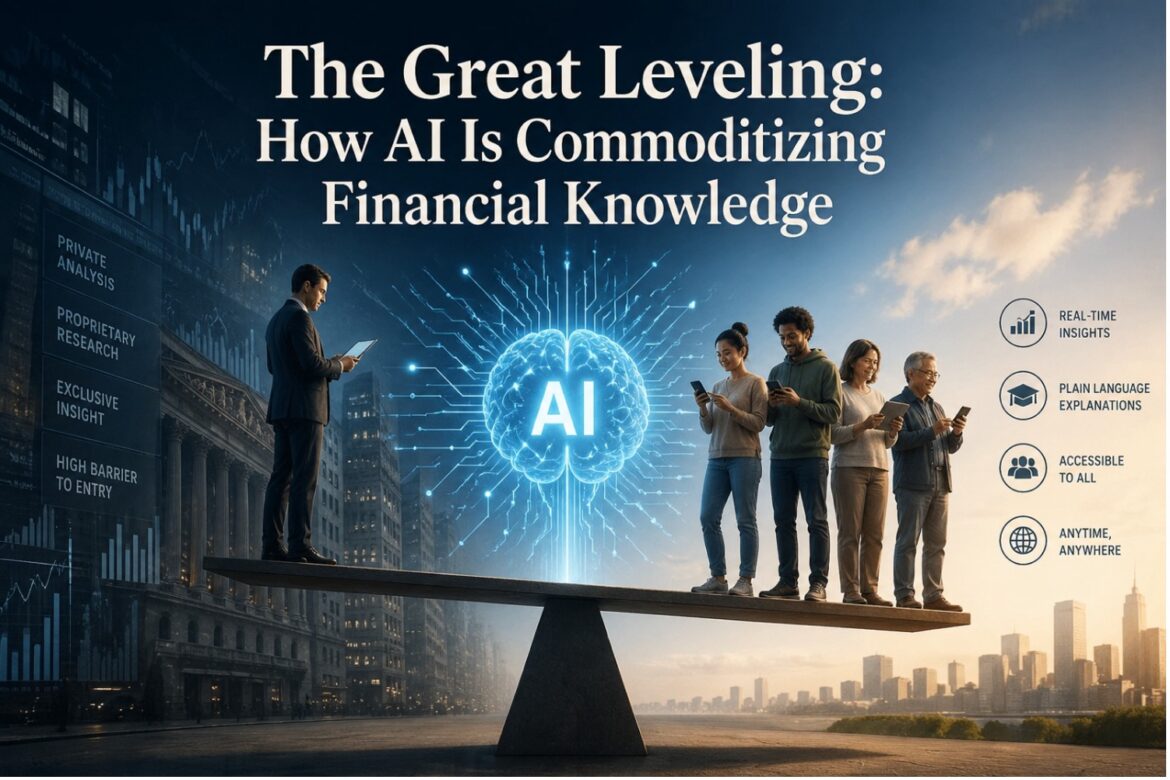
When any client can summon a CFP-grade portfolio analysis in seconds, the question is no longer what you know — it’s whether you’re worth knowing.
For the better part of a century, financial expertise was a moat. The wealth manager who understood tax-loss harvesting strategies, Monte Carlo simulations, and the nuanced interplay between estate law and portfolio structure held a commanding asymmetric advantage over their clients. Knowledge was power. Knowledge was also billable hours.
That moat is now evaporating at a rate that should alarm every advisor still billing on the old model. The force doing the draining is not another human competitor — it is artificial intelligence, specifically the large language model systems that have become fluent in the full breadth of financial planning literature, regulatory filings, tax code, market history, and behavioral economics research. What once required a decade of credentialed experience to internalize can now be surfaced by a client on their phone before walking into your office.
This is the commoditization of financial knowledge — and it is not coming. It is already here.
| 73% of HNW clients research AI tools before advisor meetings | $4.7 T in AUM expected to migrate to AI-augmented platforms by 2028 | 3× faster: AI-first firms onboarding next-gen clients |
The Three Pillars of Knowledge That Are Falling
To understand the disruption, it helps to categorize what financial advisors have historically sold. At its most reductive, clients came for three things: technical knowledge, product access, and behavioral guidance. AI has surgically dismantled the first two, and is beginning to threaten the third in ways that most of the industry has not yet internalized.
Technical knowledge — understanding tax-efficient withdrawal sequencing, Roth conversion ladders, charitable giving vehicles, and options overlay strategies — is now functionally available to any literate adult with internet access. Models trained on the full breadth of CFA curriculum, IRS publications, academic finance journals, and practitioner case studies can walk a retail investor through concepts that would have required a fee-only planner’s engagement just five years ago.
Product access was the second pillar. For decades, advisors served as gatekeepers to institutional instruments: separately managed accounts, alternative investments, private credit, structured products. That access differential is collapsing as direct indexing platforms, fractional alternatives marketplaces, and AI-curated model portfolios democratize instruments once reserved for $5M+ relationships. The wrapper of exclusivity has come undone.
“The advisor who survives the next decade is not the one who knows the most. It is the one who is most trusted — and trust is not a dataset.”
What AI Cannot (Yet) Replicate
Here is where honest analysis demands some precision. The doom narrative, while containing a sharp truth, overstates the totality of the disruption. There are dimensions of the advisory relationship that remain stubbornly, perhaps permanently, human.
The first is genuine behavioral coaching under stress. When markets fall 30% in six weeks and a client’s retirement timeline telescopes into view, the cognitive and emotional weight of that conversation is not something a chatbot resolves with actuarial precision. The highest-value intervention in wealth management is not the investment policy statement — it is the 11pm phone call that prevents a client from liquidating their equity allocation at exactly the wrong moment.
The second is integrated life planning. A client navigating a divorce, a business sale, an inheritance, and a child’s college funding simultaneously needs not just accurate analysis across all four domains, but a coherent synthesis of tradeoffs that accounts for their specific psychology, family dynamics, risk tolerance evolution, and legacy goals. AI can model each scenario. It cannot hold the full person.
The third is accountability. There is a meaningful difference between receiving a recommendation from an AI system and receiving one from a fiduciary who will sit across the table from you at your next annual review — who has skin in the relationship, and who is legally and ethically bound to act in your interest.
The Firms Already Getting This Right
The response from the industry’s leading edge has been instructive. The smartest advisory practices are not fighting AI commoditization — they are weaponizing it. They have restructured their value proposition around the exact things AI cannot deliver, while using AI to dramatically increase the efficiency of the things it can.
In practice, this looks like advisors using AI to prepare meeting agendas, stress-test portfolios, draft financial plans, and monitor tax optimization opportunities at a scale previously impossible. What used to require two junior analysts now runs in the background automatically. The advisor arrives at every client meeting with richer data, sharper scenario modeling, and more time for the conversation that actually matters.
| ◈ AI as Infrastructure
Use models to automate plan preparation, tax monitoring, portfolio rebalancing alerts, and compliance documentation. Reclaim 40–60% of analytical hours. |
◉ Specialize Ruthlessly
The generalist wealth manager is most exposed. Deep vertical expertise — physicians, founders, divorcees, athletes — commands premiums AI cannot undercut. |
| ◇ Expand the Relationship
Move from investment manager to full-life CFO. Cash flow coaching, estate coordination, family governance, and insurance architecture add irreplaceable value. |
◎ Proactive Communication
AI enables near-real-time client outreach at life events, market inflection points, and tax deadlines. Presence and responsiveness deepen trust faster than returns. |
A Concrete Action Agenda
For practitioners seeking to act rather than simply brace, the following seven imperatives represent the architecture of a sustainable advisory practice in an AI-saturated market.
- Audit your value proposition ruthlessly
List every service you provide and ask: can a client get this free from an AI tool today? For every ‘yes,’ either eliminate the service, reprice it, or find a differentiated delivery that makes the human version worth paying for.
- Adopt AI tools immediately
Advisors who are unfamiliar with AI financial planning tools will be embarrassed by knowledgeable clients within the year. Fluency with these tools is now table stakes, not a competitive advantage.
- Build a niche deep enough to be defensible
Pick a client archetype — business owners, physicians, multi-generational family wealth — and go deep. Contextual expertise in a specific life situation is genuinely difficult to replicate.
- Invest in behavioral coaching capability
The most durable differentiator in the next decade will be the ability to guide clients through emotional decision-making under uncertainty. This is a learnable skill — read, train, and deploy it intentionally.
- Redesign the client experience around presence
Clients who stay with human advisors will do so because of the relationship. Systematize touchpoints, improve communication cadence, and make every interaction feel designed for that specific person.
- Expand service scope to justify your fee
If you are managing only investments, you are most exposed. Integrating estate planning coordination, tax strategy, insurance review, and cash flow optimization creates stickiness that pure performance cannot.
- Think in platforms, not practices
Build client communities, IP through content and education, and referral ecosystems that AI cannot replicate. Authority, reputation, and network are the new moats.
The Uncomfortable Final Verdict
It would be a comfortable lie to tell the financial services industry that this transition will be smooth. It will not be. The advisors and firms whose practices were built on informational advantage face a genuine structural challenge. The transition required is not an adjustment. It is a reinvention.
But reinvention is not disappearance. The financial services industry will not be automated away. The complexity of human financial lives — with their marriages, inheritances, fears, ambitions, conflicting priorities, and irrational attachments — ensures that the need for human guidance will persist.
The advisor who prospers in 2030 will not be the one who knows the most about portfolio construction. It will be the one who is most known, most trusted, and most present in the lives of clients navigating the most consequential financial decisions of their existence. In a world where knowledge is free, wisdom — hard-won, relationship-earned, contextually applied — becomes priceless.
The great leveling of financial knowledge is not the end of the advisor. It is the end of the advisor as information broker. What rises in their place is something older, and more valuable: a counselor.
If you find this valuable let us know how we can help by scheduling a free consult.