The honest answer may be the most important leadership lesson of our era.
By Curtis C. Brown, Jr.
Founder and CEO, Tier1 Level Consulting | 4Cast IQ
Every leader I have coached over the past four decades has carried bias into the room. That is not an indictment. It is a human condition. The question that now sits at the center of executive development is whether artificial intelligence can do what decades of diversity training, 360 feedback, and leadership coaching have struggled to accomplish: actually eliminate bias from the way leaders think, decide, and lead.
The answer is both more promising and more dangerous than most leaders realize.
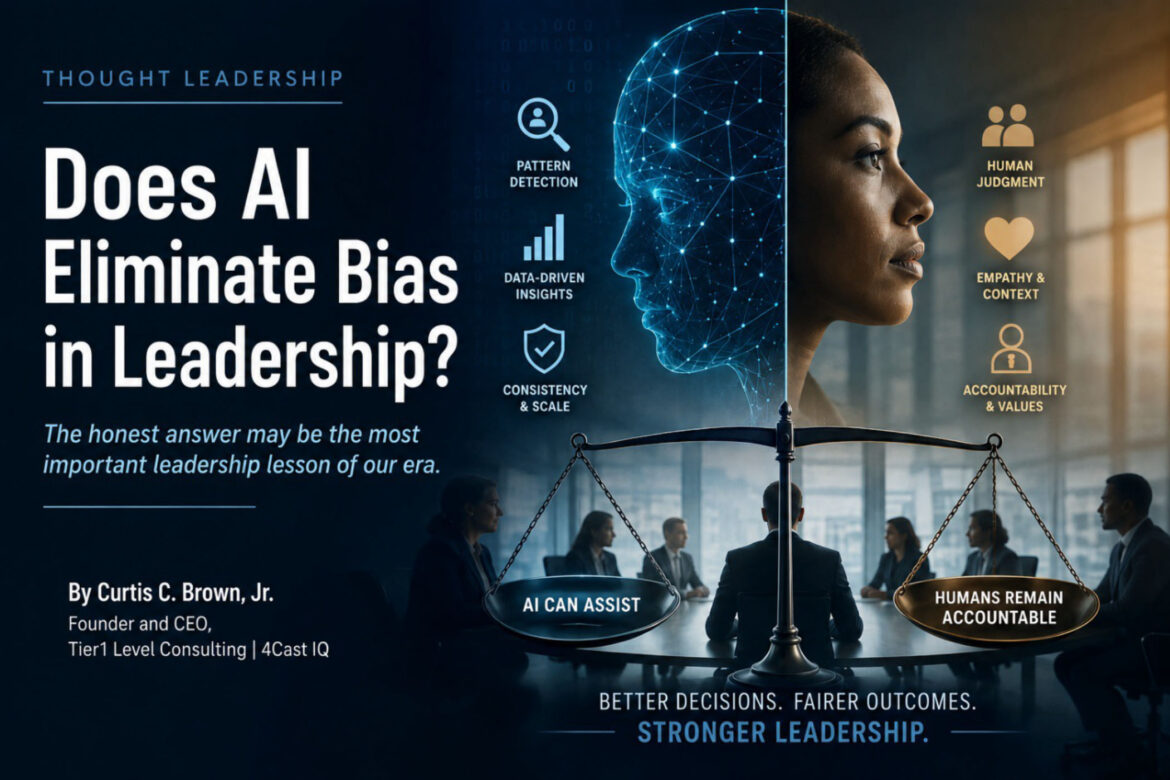
AI may assist. Humans remain accountable
The Bias Problem Is Structural, Not Just Personal
Bias does not stay contained inside one person. When a leader holds a bias, it scales. Every hire, every promotion, every resource allocation decision, every coaching conversation carries that bias forward. What began as a blind spot in one individual becomes embedded in team culture, organizational norms, and eventually institutional practice. This is why bias in leadership is fundamentally a structural problem. It compounds. And it compounds quietly, because the leader most affected by bias is typically the least equipped to see it.
For decades, the primary interventions have been human-centered: awareness training, structured interviews, diverse hiring panels, anonymous feedback systems. These tools have produced meaningful progress. They have not produced transformation. Bias is adaptive. It finds new expressions as fast as organizations design new guardrails.
Enter artificial intelligence.
What AI Can Actually Do
Let me be precise, because precision matters here. AI does not think. It does not hold opinions. It does not favor one candidate over another based on a handshake, a familiar accent, or a shared alma mater. These are genuine structural advantages that AI brings to certain decision-making processes.
Here is where AI creates legitimate, measurable value in reducing bias:
- Resume screening without demographic signals: AI can evaluate qualifications without processing names, addresses, graduation years, or other proxies for identity, reducing the pattern-matching that leads to affinity bias in early screening stages.
- Language analysis in performance reviews: AI tools can flag patterns in written feedback, identifying when language used to describe one group differs structurally from language used to describe another, often surfacing disparities that reviewers never consciously intended.
- Consistency in structured assessments: AI can apply identical evaluation criteria across thousands of candidate responses, removing the fatigue, mood, and contextual variance that cause human evaluators to drift from their own standards.
- Data-driven pattern recognition: AI can surface statistical anomalies in promotion rates, pay decisions, and development investments that might take years for a human analyst to detect, if the organization ever looked at all.
These are not trivial contributions. In high-volume, data-rich environments, AI-assisted processes have demonstrated real reductions in discriminatory outcomes. The evidence is strongest in early-stage recruitment and compensation equity analysis. Leaders who dismiss these capabilities are leaving a powerful tool unused.
AI removes certain frictions. It does not remove human judgment, and human judgment is where bias lives at its deepest level
What AI Cannot Do
This is where the conversation requires honesty, because the risk of overstating AI’s capacity here is significant. First, AI is trained on historical data. And historical data is the archive of every bias humanity has ever acted upon. An AI model trained on decades of hiring decisions from an industry that systematically undervalued certain groups will learn, with statistical precision, to replicate that undervaluation. This is not a theoretical concern. It has been documented in hiring algorithms, lending models, and clinical diagnostic tools. The model learns what the data teaches.
Second, bias lives in the questions leaders choose to ask, not just the answers they evaluate. AI cannot tell a leader that they are asking the wrong question. It cannot flag that a performance review process is measuring the wrong outcomes. It cannot identify that a team’s definition of a high performer was built around a profile that excludes entire categories of contribution. These are judgment calls that require human insight, institutional knowledge, and moral accountability.
Third, and most critically: the leader still makes the final call. AI can surface information. It can flag patterns. It can recommend. But the decision, and the accountability for that decision, belongs to the human in the chair. A leader who uses AI output as cover for a biased decision has not eliminated bias. They have automated it.
The Leadership Accountability Gap
Here is the pattern I observe most frequently in organizations adopting AI-assisted processes: the technology improves early-stage screening, and leaders interpret that improvement as permission to reduce their own vigilance downstream. This is exactly backward. If AI filters the first one hundred candidates with greater consistency, the decisions that remain, the interview, the offer, the onboarding, the first assignment, the coaching investment, become even more consequential. These are entirely human interactions. And human interactions are the territory where bias is most active and least visible.
The leader who believes AI has handled the bias problem has created a more dangerous condition than the one they started with. They have reduced their accountability precisely where accountability matters most.
The highest-performing leaders I work with use AI as a signal-amplifier, not a decision-replacer. They want AI to surface patterns they cannot see. They reserve judgment for themselves and then subject that judgment to structured challenge. They build systems designed to make their own bias visible to others. That is not weakness. That is the architecture of serious leadership.
Workflow is the New Alpha. The leader who builds the right system consistently outperforms the leader who relies on instinct alone
A Framework for Bias-Aware AI Leadership
For leaders ready to integrate AI meaningfully into their decision-making architecture, here is the structure I recommend:
- Separate AI’s domain from yours.
Use AI for pattern recognition, consistency, and scale. Reserve human judgment for context, relationships, and final decisions. Never blur this boundary in either direction.
- Audit your AI inputs before you trust your AI outputs.
Every AI model reflects the biases embedded in its training data. Before deploying any AI tool in a talent or leadership context, demand a bias audit. Ask who built the model, on what data, and what disparate impact analysis was conducted. If the vendor cannot answer these questions, the tool is not ready.
- Build structural accountability into every high-stakes decision.
AI can assist the analysis. It cannot replace the obligation to invite dissenting perspectives, document the reasoning behind decisions, and hold that reasoning accountable to review over time.
- Treat bias as a workflow problem, not a character problem.
Leaders who frame bias reduction as a moral failing get defensiveness. Leaders who frame it as a workflow design challenge get action. AI is most powerful when it is embedded in a system built to surface what human instinct reliably misses.
- Measure outcomes, not intentions.
AI gives leaders unprecedented access to outcome data. Use it. Track promotion rates, development investments, performance ratings, and retention patterns across every dimension of team composition. If the data reveals disparate outcomes, investigate the process, not the people.
The Honest Answer
Does AI eliminate bias in leadership?
No. AI cannot eliminate what originates in human cognition, institutional history, and the unchecked assumptions embedded in the data it learns from.
But AI, deployed with discipline and accountability, can make bias more visible, more measurable, and more structurally difficult to act on without awareness. That is not a small contribution. It is genuinely meaningful progress, if leaders are honest about what it does and does not do.
The leaders who will derive the most value from AI are not the ones who hand decisions to the technology. They are the ones who use AI to see more clearly, then bring their full judgment and accountability to what they see.
That is the standard. AI may assist. Humans remain accountable.
About the Author
Curtis C. Brown, Jr. is the Founder and CEO of Tier1 Level Consulting and 4Cast IQ. With more than 40 years of experience in financial services, including senior leadership at Merrill Lynch, Curtis works at the intersection of AI strategy, executive development, and practice management for wealth management professionals. He is a published author, speaker, and architect of the Guided Intelligence System, a practitioner-grade AI operating platform for advisor teams.