By Curtis Brown CEO Tier 1 Level Consulting Group
Companies across the wirehouse channel and the independent RIA space are investing heavily in artificial intelligence. Copilots, large language models, agents, governance policies, prompting workshops. Yet many leaders are still asking a simple question:
Where is the return?
Where are the productivity gains? The added capacity? The improved client experience? Perhaps we are asking AI to perform before we have prepared the organization, or the AI itself, to succeed.
Becoming AI-ready takes more than buying technology. It takes strategy, workflow redesign, education, governance, and one step that gets almost no attention:
Organizations must not only educate their people about AI. They must educate their AI about the organization.
Strategy Before Technology
Before selecting another platform, leadership should be able to answer what AI will do for the firm, how it will strengthen client relationships, and what return the investment should produce. These are business questions, not technology questions. If AI gives an advisor, whether at a wirehouse or an independent RIA, five additional hours a week, the real question is what happens to those five hours. The value chain runs from AI to capacity to higher-value human activity to a better client experience to growth.
The Overlooked Half of AI Education
Most firms focus entirely on teaching employees to use AI. Far fewer ask the reverse question: what has the AI been taught about the employee, the client, and the business?
A financial advisor handed a powerful AI model with no context about their book, their niche, their team, or their goals will get generic output. Before AI can offer genuinely useful business advice, it needs a real profile of the practice, and it should interview the advisor to surface what it does not yet know rather than assume.
That shift, from data-loading to structured discovery, changes AI from a tool that waits for perfect prompts into a participant that helps identify what matters.
What AI Still Cannot See
AI may know a client’s age, portfolio size, and risk profile. It will not know that a spouse recently died, or recognize the hesitation in a client’s voice during a difficult conversation. AI output is an input into judgment, not a substitute for it. A recommendation should always remain open to debate on its merits.
Protecting What Walks Out the Door
Every year, firms lose enormous institutional knowledge when advisors retire, teams transition, or associates who have worked with families for decades move on. This risk exists identically inside a wirehouse and inside an independent RIA. Properly governed, AI can become the layer that captures, retrieves, and refines that knowledge before it walks out the door, without turning into a museum that resists change as markets, regulations, and client expectations evolve.
The Real Measure
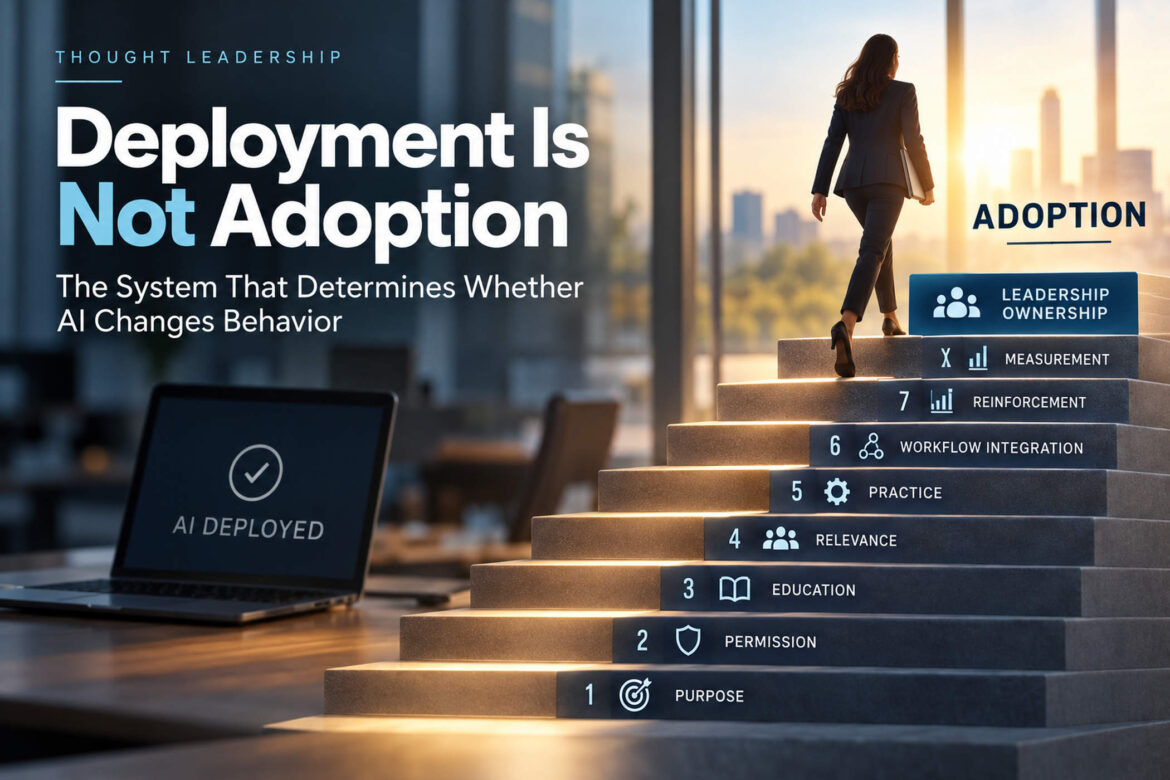
Logins and license counts are activity metrics. The relevant questions are about outcomes: Did client-facing time increase? Did pipeline conversion improve? Did capacity grow? Access is not adoption. Adoption is not integration. Integration is not transformation.
We have invested heavily in teaching our people how to use AI. How much have we invested in teaching our AI to understand our people, our clients, and our business?
That answer may say more about a firm’s AI readiness, wirehouse or RIA, than the size of its technology budget.