THOUGHT LEADERSHIP
Deployment Is Not Adoption
The System That Determines Whether AI Changes Behavior
Every wealth management firm can point to the same milestone: the platform is live. Compliance approved it. Employees completed the training. The dashboard shows logins.
And yet, walk the floor six months later and very little has changed. Advisors still spend their mornings the same way. Meeting preparation still takes the same forty-five minutes. The AI tool sits open in a browser tab, occasionally consulted, rarely relied upon.
This is the gap most firms miss: deployment is not adoption. You can purchase a capability, approve it, and train people on it, and still achieve almost no behavioral change. Adoption is not a technology event. It is an organizational one.
Adoption occurs when a new capability becomes part of how people routinely perform their work, not something they have merely been given access to.
That distinction should sit at the center of any firm’s AI strategy, because it reframes the entire problem. The question is no longer “did we roll it out.” The question is “did behavior change.”
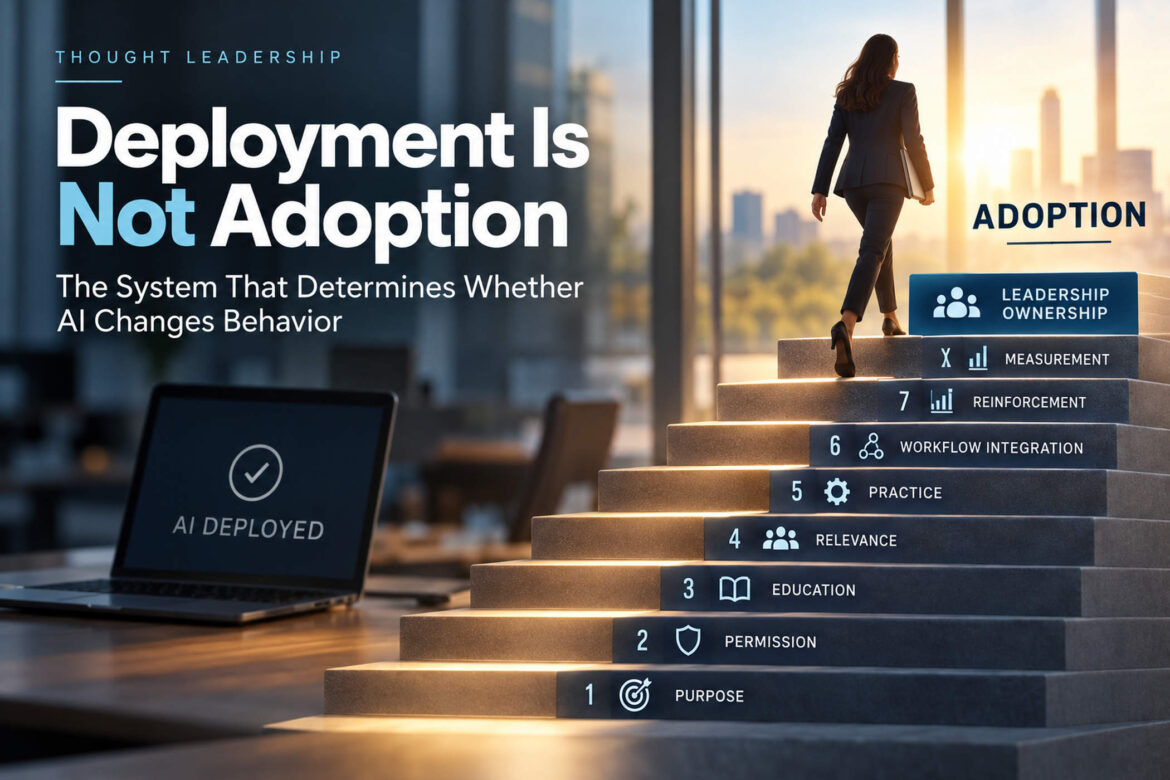
The Eight Components of Adoption
Organizational change generally depends on a consistent set of conditions. AI raises the stakes on each of them.
- Purpose.
People need to understand the business problem before they care about the technology. “We are rolling out generative AI” motivates no one. “We want advisors to recover five hours a week for clients and business development” does. Purpose has to connect to outcomes employees already value: less administrative drag, faster preparation, stronger client conversations, easier compliance work, better prospecting.
- Permission.
This is the quiet killer in financial services. Advisors may have access to a tool and still be afraid to use it. What can I put into it? What can’t I? Is someone monitoring my prompts? Can this material go in front of a client? Governance is not separate from adoption; good governance accelerates adoption, because it draws a safe operating boundary people can trust.
- Education.
Most firms confuse tool training with AI literacy. Showing someone where the prompt box is does not teach them how to think with the tool. Real education covers what AI is good at, where it fails, how to prompt, how to verify, and where judgment still belongs to the human.
- Relevance.
This may be the most commonly missing ingredient. An advisor, a branch manager, a compliance officer, and a client associate should never receive the same AI training, because they don’t do the same job. Prepare me for tomorrow’s client meetings. Help me spot recruiting opportunities. Help me investigate an exception faster without outsourcing judgment. Reduce the repetitive work in meeting prep. The unit of adoption is not the tool. It is the use case.
- Practice.
Watching a demonstration builds enthusiasm. It does not build competence. People need structured practice on their own work: learn, demonstrate, practice, apply, repeat. Don’t just show an advisor a meeting-prep prompt. Have them bring a real upcoming meeting, build the prompt, generate the output, critique it, improve it, and run it again on their own. That repetition is where training becomes behavior.
- Workflow Integration.
This is where most enterprise AI programs quietly break down. If using AI means stopping what you’re doing, opening another application, and inventing a question to ask it, the habit fades once the initial novelty wears off. AI has to sit inside the workflow, not beside it: CRM into meeting prep into AI, email into AI-drafted response into human approval, pipeline into AI-assisted opportunity analysis, compliance alert into AI-assisted investigation into human judgment.
- Reinforcement.
People revert to familiar behavior unless something reinforces the new one. That reinforcement comes from managers, peer champions, success stories, office hours, and simple recognition. A branch manager who asks in a weekly meeting, “What did you use AI for this week that saved you time or improved a client outcome?” sends a message no policy memo can: this is becoming how we work here.
- Measurement.
Most firms default to counting logins, which measures almost nothing useful. Adoption should be measured on three levels: activity (are they using it), behavior (has the work itself changed), and outcome (is performance improving). Leadership shouldn’t care that 72 percent of advisors logged into the platform. They should care that meeting prep dropped from forty-five minutes to fifteen, that prospecting activity rose, that client response times improved.
The Ninth Component: Leadership Ownership
There is a component above all eight, and it may matter more than any of them: leadership has to own the behavior change.
Technology can deploy a tool. Compliance can govern it. Learning and development can train it. But only management can lead the shift in daily habits. That requires leaders with enough AI fluency to ask sharp questions, model the behavior themselves, spot opportunities, remove obstacles, and hold their teams accountable for using what has been given to them.
Skip this step and employees notice the contradiction quickly: leadership calls AI strategically important, yet nobody is managed any differently because of it. The initiative becomes one more piece of enterprise software nobody opens.
From Framework to Architecture
Put together, this becomes something more durable than a training curriculum:
Purpose, Permission, Education, Relevance, Practice, Workflow, Reinforcement, Measurement, with Leadership surrounding the entire system, and a simple chain underneath it: Strategy drives Behavior, Behavior drives Workflow, Workflow drives Outcome.
Most firms already have pieces of this in place: some governance, some training, a few use cases, occasional measurement. What they lack is the architecture that connects those pieces into a single system of behavior change.
That is the real opportunity in front of wealth management right now. Not selling firms another round of AI training, but helping them solve the more expensive problem: turning AI investment into sustained organizational behavior and measurable business results.