A TIER1 LEADERSHIP PERSPECTIVE
By Curtis C. Brown, Jr. CEO, Tier1 Level Consulting
The Phone Call That Never Stopped Mattering
Years ago, during one of the hardest stretches of my career leading a Merrill Lynch branch through a market downturn, an advisor pulled me aside after a brutal week. Production was down. Morale was lower. He said something I have never forgotten.
“Curtis, my clients do not stay because my portfolio is better than the one across the street. They stay because they know I will answer the phone when the market falls apart.”
That sentence has stayed with me for decades, and it has never been more relevant than it is right now. Clients rarely remember every recommendation an advisor makes. They remember how that advisor made them feel when the world got uncertain. Employees rarely remember what a leader said in an annual meeting. They remember how that leader behaved when things became difficult. That is not a soft observation. It is the entire argument of this article.
The Problem AI Creates for Every Leader
Artificial intelligence has made information abundant. Research, forecasting, drafting, and even portfolio commentary that used to separate a top advisor or a strong leader from an average one are now available to almost anyone, instantly, at almost no cost. That is a genuine gain. It is also a genuine problem, because when the tools are the same for everyone, the tools stop being the differentiator.
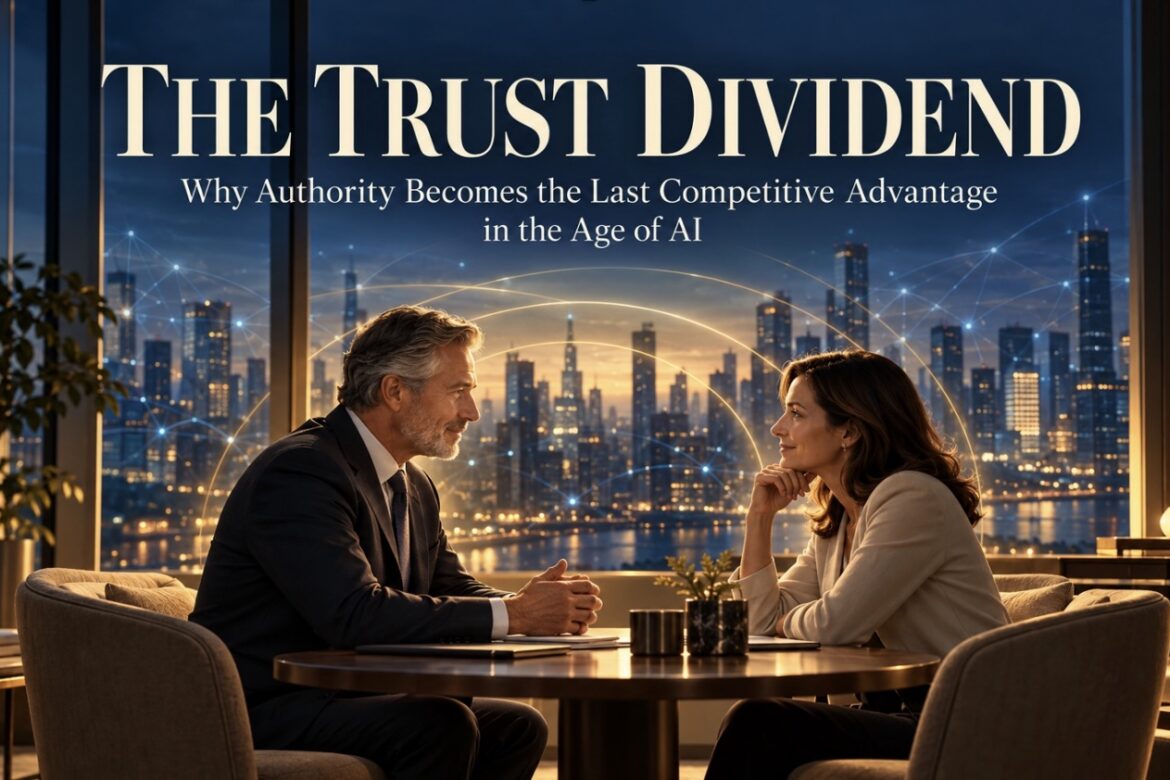
So what is left to compete on, once the technology itself is no longer scarce? Not visibility. Not content volume. Not who posts the most often. What remains, and what becomes more valuable precisely because it cannot be automated, is authority. And authority is not built from titles, followers, or algorithms. It is built from one asset that AI cannot manufacture: trust.
AI increases visibility. Leadership increases credibility. Only character creates authority. AI can write an advisor’s articles. It cannot write that advisor’s reputation. AI scales information. Leaders scale trust. Those are not slogans. They describe exactly what is happening inside every financial services firm, every branch, and every executive team right now.
The Tier1 Trust Dividend
Here is the model I use with the executives and advisors I coach. Trust is not a personality trait. It is the output of three disciplines, practiced consistently enough that people stop noticing them and start relying on them.
| CHARACTER | JUDGMENT | CONSISTENCY |
| Who you are. Integrity, authenticity, humility. | How you think. Decision quality, critical thinking, responsible use of AI. | What people experience every day, not once. |
Character, judgment, and consistency together produce trust. Trust, sustained over time, produces results. That is the whole chain, and it is worth noticing what is missing from it. Social media does not appear anywhere in this model, because social media amplifies authority. It does not create it.
What the Research Actually Shows
I try not to lean on statistics for their own sake, but three findings released this year are too directly on point to leave out.
The 2026 Edelman Trust Barometer found that employees trust their own employer more than any other institution, with roughly 78 percent expressing confidence in it. Yet the same study found a striking credibility gap at the top: 75 percent of people say CEOs are obligated to help bridge divides of trust, but only 44 percent say their CEO actually does it well. That is a 29 point gap between what leaders are expected to do and what employees see them doing. The report also found that trust is becoming more insular, with people increasingly placing confidence only in those closest to them and withdrawing it from institutions and distant leaders. [Source 1]
Microsoft’s 2026 Work Trend Index found a nearly identical pattern on the AI side. Employees are adopting AI faster than their organizations can support them. Only about 26 percent of AI users say their leadership is clearly and consistently aligned on an AI strategy, and Microsoft found that organizational factors such as culture and manager support account for roughly twice the impact on AI outcomes that individual skill and mindset do. In other words, the technology is not the bottleneck. Leadership is. [Source 2]
PwC’s 29th Global CEO Survey, released at Davos in January, found CEO confidence in revenue growth at its lowest point in five years, even as AI investment keeps climbing. PwC’s own analysis now treats trust as a measurable financial asset, not a reputational nicety, reporting a meaningful gap in shareholder returns between companies with the fewest trust concerns and those with the most. [Source 3]
Three different research organizations, three different lenses, and one shared conclusion. AI strategy without leadership strategy creates organizational risk. Technology can scale a company’s output. It cannot substitute for a leader people are willing to follow.
What Rebuilding a Culture Actually Looks Like
I have led teams through their hardest years, not their easiest ones. What I learned firsthand is that culture does not turn around because of a memo, a new tool, or a motivational meeting. It turns around because people watch what a leader does when the numbers are bad, and they decide, based on that behavior alone, whether the leader is worth following. Employees do not evaluate leadership during the good quarters. They evaluate it during the hard ones, and that verdict, once reached, is very difficult to reverse.
That is the same lesson the advisor taught me on that difficult afternoon years ago, just applied one level up, from the client relationship to the organization itself. Trust is not built during bull markets. It is built during difficult conversations.
What This Means for Wealth Management Leaders
Advisor-Client Relationships: Clients are not buying a portfolio strategy. They are buying confidence. AI can improve the quality of a financial plan. It cannot replace empathy during market volatility.
Recruiting: Top advisors do not join firms. They join leaders. Culture, and the trust that culture is built on, starts at the top of a branch or a complex, not in a recruiting deck.
Coaching: People improve faster when feedback comes from someone they already trust. Without trust, feedback lands as criticism. With trust, the same feedback becomes development.
Succession Planning: Future leaders are not identified by production numbers alone. They are identified by the credibility they have already earned, because teams follow people they already trust.
AI Governance: Policy documents do not create responsible AI use. Leaders do. When employees trust leadership, they are far more likely to ask questions, report concerns, follow governance guidelines, and adopt new tools responsibly.
The Trust Account
Every interaction a leader has either makes a deposit into this account or a withdrawal from it. There is no neutral interaction.
| DEPOSITS | WITHDRAWALS |
| Listening | Broken commitments |
| Recognition | Poor communication |
| Transparency | Micromanagement |
| Keeping promises | Inconsistency |
| Coaching | Hidden agendas |
| Accountability | Lack of empathy |
| Integrity | Ignoring feedback |
The Executive Challenge
Before your next leadership meeting, ask your team one question. Where in our organization did we make a withdrawal from the trust account this quarter, and did anyone notice before a client or an advisor did? Firms that can answer that question honestly are the ones building the kind of authority AI cannot replicate.
“AI will reshape the way we work. Trust will determine who people choose to follow.”
Organizations do not outperform because they have the most visible leaders. They outperform because they have leaders whose judgment, integrity, and consistency earn trust, internally and externally. In the AI era, authority is no longer measured by attention. It is measured by the confidence others place in your decisions.
Curtis C. Brown, Jr.
Founder and CEO, Tier1 Level Consulting, LLC
Sources
- Edelman Trust Institute. “2026 Edelman Trust Barometer.” Edelman, January 2026. https://www.edelman.com/trust/2026/trust-barometer
- Microsoft. “2026 Work Trend Index Annual Report: Agents, Human Agency, and the Opportunity for Every Organization.” Microsoft WorkLab, 2026. https://www.microsoft.com/en-us/worklab/work-trend-index/agents-human-agency-and-the-opportunity-for-every-organization
- PwC. “29th Global CEO Survey: Leading Through Uncertainty in the Age of AI.” PwC, January 2026. https://www.pwc.com/gx/en/ceo-survey/2026/pwc-ceo-survey-2026.pdf