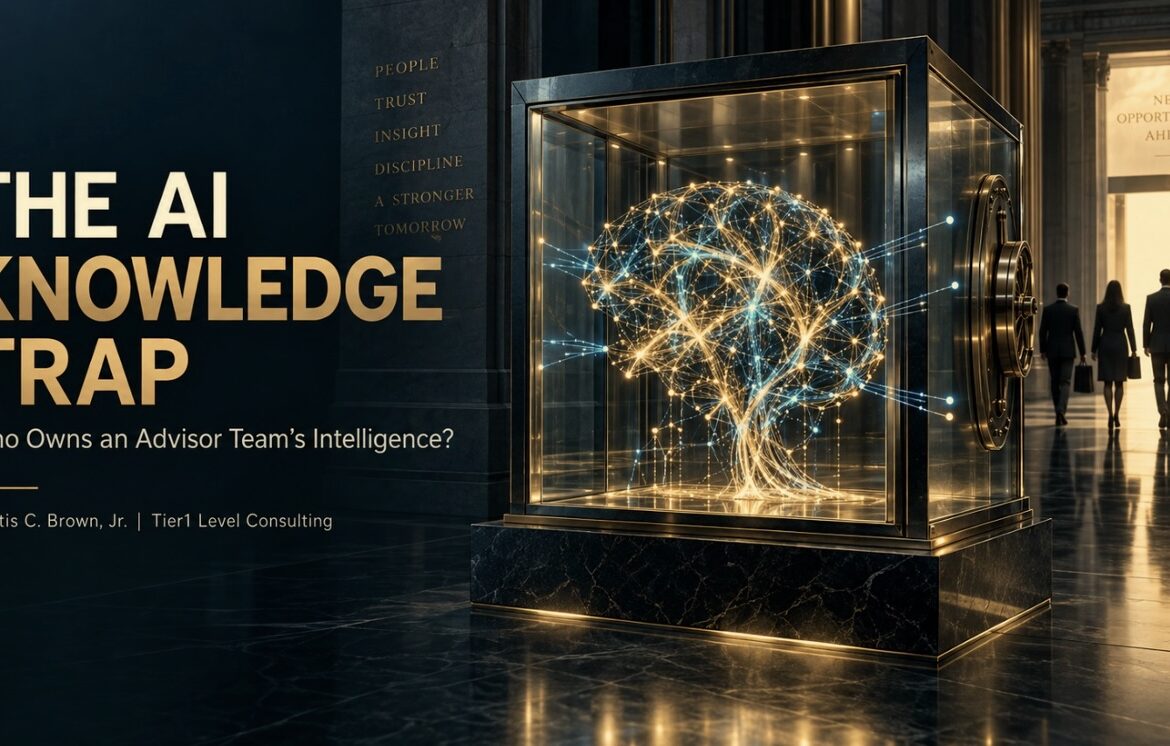
Will the next recruiting battle be fought over who owns an advisor team’s intelligence?
By Curtis C. Brown, Jr. | Tier1 Level Consulting, September 2026
A $1.2 billion team at a major wirehouse spends three years building a private AI assistant. It drafts prep notes before every client meeting, flags service gaps before they become complaints, and routes new leads to the right advisor on the team. Then a recruiter calls. The payout is right. The platform is right. The culture fits. Then someone on the team asks the question nobody used to have to ask: what happens to the assistant?
That question is becoming a live one faster than most firms realize. Eighty-five percent of financial advisors have now adopted some form of AI-integrated technology, and more than half of those advisors report saving at least four hours a week because of it, according to AssetMark’s 2026 advisor survey. Advisors are not just summarizing articles anymore. They are automating meeting notes, performance reporting, research summaries, and risk monitoring, the exact building blocks of the “operating knowledge” this article is about.
For decades, financial advisor recruiting has revolved around a familiar set of considerations: compensation, brand, platform, technology, transition support, product access, leadership, and culture. Those factors will remain important. But within the next two to three years, another question may begin to influence advisor movement: can an advisor take the team’s AI-enabled operating knowledge to the next firm?
An advisor may be able to move relationships, people, and permitted business information under the applicable rules. Yet the team may have spent years converting its collective experience into prompts, custom assistants, workflow instructions, decision rules, service routines, and institutional memory. If those assets remain inside the former firm’s technology environment, the advisor can leave while a meaningful part of the practice stays behind.
That possibility creates a new recruiting and retention battleground. It also raises an uncomfortable question for the industry: if the people can move but the intelligence they built cannot, how portable is the practice really?
The rise of the AI enabled practice
AI adoption in wealth management is no longer a fringe behavior, but it is uneven in depth. RIA-affiliated advisors have adopted AI at a noticeably higher rate than wirehouse and broker-dealer advisors (91 percent versus 81 percent, per AssetMark), and most firms are still concentrated on approving tools and writing basic use policies rather than building true knowledge architecture. Morgan Stanley, among the furthest along, has rolled out a proprietary AI assistant and AI-powered meeting notetaker built on an OpenAI partnership, a signal that at least some firms are already constructing the kind of firm-embedded intellectual capital this article describes.
Inside individual teams, the more advanced practices are developing reusable prompts, specialized assistants, research processes, meeting workflows, client-service sequences, and connections to the CRM and other firm systems. Over time, these assets capture more than isolated instructions. They begin to encode how a team thinks and works: how it prepares for a complex client meeting, recognizes risk, segments relationships, coordinates responsibilities, follows up on opportunities, and applies professional judgment consistently.
This can be described as AI-embedded institutional knowledge: the collective knowledge of a team converted into digital workflows, model instructions, contextual memory, agents, templates, and decision logic. It is not simply data, and it is not simply software. It is accumulated practice intelligence made operational.
What might be left behind
When an AI-enabled team changes firms, the potential loss could extend far beyond access to a preferred model such as Claude, OpenAI, or Microsoft Copilot. What may remain behind is the architecture the team built around that model.
| Knowledge asset | What it contains |
| Prompt and instruction libraries | Reusable directions refined through repeated client and team situations. |
| Custom assistants and agents | Applications configured around the team’s roles, standards, and recurring work. |
| Workflow intelligence | The sequence of tasks, handoffs, checkpoints, and escalation rules that make the practice function. |
| Relationship context | Patterns, preferences, histories, and service expectations derived from client interactions. |
| Decision memory | Past choices, rationales, exceptions, and lessons that inform future judgment. |
| Team operating knowledge | The practical understanding of who does what, when, why, and under which conditions. |
An advisor separated from these assets may retain decades of personal experience but lose the operational structure that made that experience scalable across the team. Rebuilding it could take months, disrupt service, and reduce productivity at precisely the moment the team is already managing a difficult transition.
A new form of golden handcuffs
Firms have long used deferred compensation, forgivable loans, proprietary platforms, and transition restrictions as golden handcuffs: financial reasons to stay that get more expensive to walk away from over time. AI may introduce a subtler version of the same idea. You may be free to leave, but the intelligent operating system your team spent years creating may not be free to leave with you.
Some firms will restrict the removal of AI assets outright. They may prohibit exports, disable accounts immediately upon departure, prevent external connections, monitor bulk downloads, retain model histories, or define prompts, agents, and workflows created during employment as firm property, the same instinct behind today’s device wipe and system access policies at departure, applied to a new category of asset.
Many of those controls will be legitimate. Firms have obligations to protect client information, confidential business data, cybersecurity, records, and proprietary methods. An advisor should not be able to remove protected information merely because it has been summarized inside an AI system or embedded in an agent.
The concern arises when a firm uses an overly broad definition of ownership to capture not only protected data and firm-funded applications, but also the general methods, reusable processes, and team knowledge that advisors helped create. At that point, protection can begin to function as a barrier to mobility, and golden handcuffs become something closer to a lock with no key on either side.
Is this a new area of law
Not entirely, and the honest answer matters more than the dramatic one. No reported dispute yet involves an advisor departing with AI-built prompts, agents, or workflows specifically. This article is anticipatory, not reactive. But the doctrinal building blocks are already being tested in adjacent fact patterns, and courts are showing early signals of how they will likely approach this question.
The clearest preview comes from a September 2025 Fourth Circuit decision, Salomon & Ludwin v. Winters, which did not involve AI at all but is structurally close to what an AI-knowledge dispute will look like. Four advisors left an RIA, formed a competing firm, and took roughly $300 million in client assets, about 30 percent of their former firm’s business. The court affirmed an injunction against the individual advisors, whose employment agreements contractually overrode Broker Protocol protections, but vacated the injunction against the new firm they had formed, since that entity was never a party to those agreements. The court also narrowed the Broker Protocol’s “raiding” exception to cover one firm poaching from another, not advisors striking out on their own. That split, personal liability under the agreements an advisor signed, separate exposure for the new firm, is very likely the template for how AI-knowledge disputes get litigated: against the individual who took the workflow, not just the firm that received it.
On the AI side specifically, the trade secret question is already being tested, just not on this fact pattern yet. Two 2025 federal cases, OpenEvidence v. Pathway Medical and OpenEvidence v. Doximity, both filed in the District of Massachusetts, involve competitors accused of using fraudulent credentials and prompt injection attacks to extract a company’s underlying AI system prompts. Neither case involves an employee taking tools to a new employer, but both are early tests of whether prompts and model instructions themselves qualify as protectable trade secrets, a threshold question any future advisor-mobility dispute will also have to answer.
What is genuinely new is the character of the asset, not the legal categories. AI-embedded knowledge can be jointly produced by an advisor’s experience, the team’s contributions, firm data, licensed technology, client context, and machine-generated output, and it may keep changing as the system is used. The most contested territory will likely be the middle layer: a prospecting workflow the advisor designed, the team refined, the firm hosted, and an AI assistant improved through repeated use. A service model containing no exportable client names but derived from thousands of client interactions. An agent whose instructions reflect the advisor’s philosophy but whose memory resides on firm systems.
Existing categories, trade secret, copyright, confidentiality, employment agreements, work-made-for-hire, fiduciary duty, will supply the vocabulary for these disputes. They were simply not written with an asset this jointly produced in mind, which means firms that write clear ownership language now, before a dispute forces the question, will be in a far stronger position than firms waiting for case law to settle it for them.
The recruiting paradox
A restrictive AI environment may make an incumbent firm harder to leave, but it may also make that firm less attractive to join. Sophisticated recruits will not want to spend years building productivity inside a system if the rules governing ownership and portability are unclear. That is the paradox: the same architecture that strengthens retention may weaken recruitment.
Top teams are beginning to ask for clarity before affiliating with a firm, not with legal language, but with plain questions:
- Which AI models and platforms can we actually use?
- If we’ve built our own prompts and playbooks, can we bring them with us?
- Can we rebuild our assistants at the new firm without taking anything that isn’t ours to take?
- Who owns what we build after we join, us or the firm?
- What happens to all of this if the relationship ends?
Particularly valuable recruits may soon negotiate AI ownership and transition terms alongside compensation, technology, and team agreements, the same way upfront money and forgivable loan terms are negotiated today.
Why a single model strategy will become a roadblock
This issue is connected to a second strategic weakness: dependence on one AI provider. OpenAI, Anthropic, Microsoft Copilot, and Perplexity are not interchangeable products, and no single provider is likely to remain best for every workflow. A firm that embeds all of its knowledge directly inside one vendor’s proprietary environment creates both advisor lock-in and enterprise vendor lock-in at the same time.
A more resilient approach is a governed multi-model strategy supported by a model-agnostic architecture. The advisor works through a consistent, firm-controlled environment, while an orchestration layer routes approved work to the appropriate model according to capability, data sensitivity, cost, speed, and risk. The lasting asset is not the model. Models will improve, decline, change price, merge, or become unsuitable for particular use cases. The durable value lives in the firm’s workflows, knowledge architecture, governance rules, and ability to move intelligently among models.
What prepared firms will need
- A defined multi-model strategy. Establish where model choice is permitted, which use cases belong on which platforms, and how providers will be replaced.
- A model-agnostic knowledge layer. Keep reusable instructions, workflow definitions, and approved knowledge separate from any single model whenever practical.
- Clear ownership rules, written before a departure, not during one. Define the treatment of prompts, agents, workflows, model histories, derivative outputs, and team-created playbooks.
- Knowledge classification. Distinguish personal capability, portable methodology, team operating intelligence, client information, and protected firm intellectual property.
- An AI transition protocol. Build a controlled review for incoming and departing teams: permitted imports, prohibited exports, reconstruction, certification, and audit trails.
- Governance and supervision. Apply consistent privacy, security, recordkeeping, validation, vendor-risk, and human-accountability standards across every approved model.
- Advisor education. Teach advisors how to build reusable workflows responsibly, not just how to log in to a tool.
The industry may need an AI transition protocol
The industry will eventually need a more precise framework for AI portability, one that neither allows unrestricted transfer of client information and proprietary firm assets, nor presumes that every method an advisor helped create belongs forever to the incumbent firm.
A workable framework would separate four categories: the individual’s general professional capability, independently developed or contractually retained methodology, jointly created team operating intelligence, and protected client or firm information. The third category will require the greatest care, because it is often co-created and genuinely difficult to disentangle. A standardized AI transition protocol could identify assets, examine their provenance, remove protected information, document ownership, and authorize the transfer or reconstruction of permissible workflows, providing far greater certainty for firms, advisors, clients, recruiters, and regulators than an unresolved dispute after the fact.
Will firms be prepared
Most firms are still focused on approving tools, writing basic policies, and preventing improper use. Those steps are necessary, but they do not yet constitute a model strategy or a knowledge-portability strategy.
The forward-looking firm will recognize that AI is creating a new class of institutional capital, and it will decide, deliberately, how that capital is created, governed, valued, retained, and, when appropriate, transferred. It will protect legitimate firm and client interests without using ambiguity as a substitute for policy.
Within the next two to three years, AI capability may begin to influence where sophisticated advisors choose to work. Firms that can receive an AI-enabled team, preserve its permissible operating intelligence, and integrate it into a governed multi-model environment will have a recruiting advantage. Firms that cannot may discover that their AI restrictions have become a barrier to attracting the very advisors they most want to recruit.
The next recruiting battle may not be fought only over clients, compensation, or platform. It may be fought over who owns the intelligence of the practice, and whether that intelligence can move when the advisor does.
Sources
AssetMark, “More Than Half of Advisors Using AI Save 4+ Hours a Week,” advisor survey of 400 U.S. financial advisors, June 24 to July 7, 2026.
InvestmentNews, “Morgan Stanley Rolls Out AI Tools Throughout Its Wealth Management Division.”
Bradley LLP, “Fourth Circuit Narrows Broker Protocol ‘Raiding’ Exception, Enforces Employment Agreements in Wealth Management Dispute,” on Salomon & Ludwin v. Winters, September 2025.
Beck Reed Riden LLP, “ChatGPT 5 and the Next Frontier in Trade Secret Law: Lessons from Ongoing AI Litigation,” discussing OpenEvidence v. Pathway Medical (D. Mass., filed Feb. 26, 2025) and OpenEvidence v. Doximity (D. Mass., filed June 20, 2025).